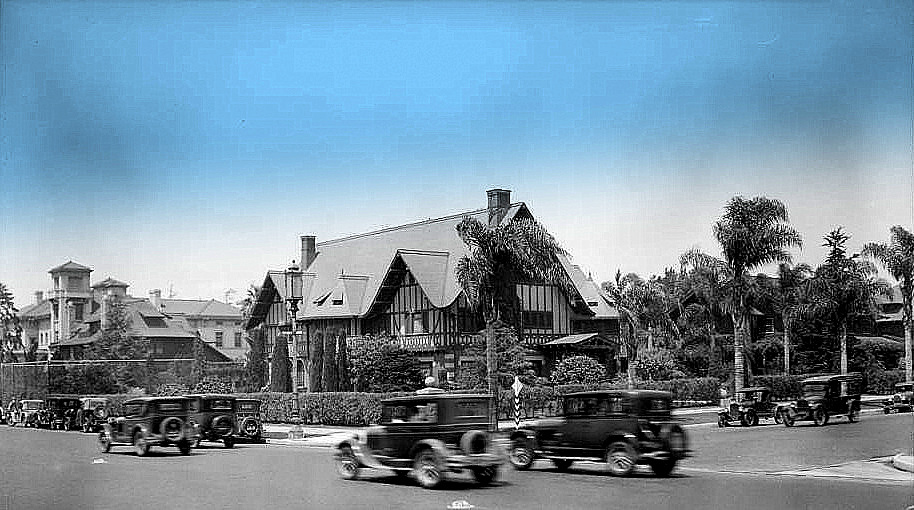
3101 Wilshire Boulevard

FOR AN INTRODUCTION TO WILSHIRE BOULEVARD, CLICK HERE


Looking more like something flown in from East Hampton or Cape Cod, the Dutch Colonial house built in 1907 at 3101 Wilshire Boulevard clearly reflects the Yankee sensibilities of its principal architect rather than the Midwestern roots of his partner and the family that commissioned it. As related in the story of 2515 Wilshire, the driving force behind the Los Angeles identity of the Neustadts was heiress Effie Gardner Neustadt of the Mississippi River town of Quincy, Illinois. Her father, Robert W. Gardner, had made a fortune by perfecting the fly-ball governor for steam-driven pumping equipment used in the burgeoning oil and gas industries. Coupled with a lifelong passion for building her own houses, Effie also doled out her legacy most generously to her two children. Even before her son Robert Gardner Neustadt's marriage to Altadena Green of Pasadena on March 14, 1907, Effie had presented the couple with not only with a 60-by-170-foot lot in the Shatto Place tract she'd bought from Clara Shatto herself, but the funds to finance a house on it by one of the top architectural firms in the city; the Department of Buildings issued a permit to begin the construction of 3101 on February 20, 1907. Since having designed Effie's own house at 2515 Wilshire five years before, Myron Hunt had partnered with Elmer Grey, another Midwesterner, born in Chicago. Still, it seems that Myron Hunt persuaded Effie and her son to accept what he might have observed on the seacoast of his native Massachusetts: something rather humble in appearance for what was to become, if briefly, the grandest residential street in town. Robert Neustadt was just 21 when he married, and he'd also already formed a business partnership with Charles E. Richards in the Richards-Neustadt Construction Company. The vast real estate holdings inherited by his mother after the death in 1896 of his father, Louis C. Neustadt, provided Effie with the canvas for her building whims; Robert's construction firm brought the plans of the architects she chose for her projects to three dimensions, including 3101. The collaboration appears to have been very tidy and lucrative, especially as repeated in and around the booming City of Angeles.


Hunt & Grey's 3101 Wilshire Boulevard soon after its 1907 completion, as compared to 22 years
later at top: By 1929, Wilshire had been widened, Bullock's-Wilshire was poised to open
across the street that fall, and the residential boulevard was deep into its eclipse.


While Effie Neustadt employed a chauffeur to get her around town, it was she who was most definitely in charge of her family's domestic arrangements, despite the increasing lack of personal mobility that would confine her to a wheelchair. Her impairment did not keep her from pursuing her hobby of building houses; if anything, it seemed to intensify her interest. On the way to building a precociously handicapped-accessible house in Altadena for herself and her son and daughter-in-law, Effie had Hunt & Grey design a palazzo that would stand prominently on the northwest corner of West Adams Street and Western Avenue (seen here), a house seemingly out of character when compared to her usual self-effacing architectural choices; perhaps it was just an early exercise in McMansion spec housing. How long Effie may have lived in the house is unclear, but she sold in 1909, the year after its completion. Also sold that year were her houses at 2515 and 2525 Wilshire; likewise, with the multi-generational Altadena house the next stop for all, Robert and Altadena, apparently unsentimental about wedding presents, likewise disposed of 3101 in late April 1909 to nouveau Angeleno Orra Eugene Monnette and his wife, née Carrie Lucile Janeway, both late of Ohio.


Orra Eugene Monnette, circa 1910


After a stint at the Hershey Arms on Wilshire, and before moving to 3101, the younger Monnettes lived in a big mission-style house his father, Mervin J. Monnette, had bought at 951 South Western AvenueAn attorney back in Toledo, Orra had come west in April 1907 at the behest of mining-mogul Mervin, who'd recently made a big-as-the-Ritz bundle speculating in Nevada mines and needed help managing his bounty. Putting his father's bonanza to work, Orra began investing in Southern California banks. After several quick mergers, he became chairman of the Citizens Trust and Savings Bank; after being asked to resign in 1922, he formed the Bank of America, a legendary name that Monnette and his fellow stockholders brought to its merger with Amadeo Giannini's Bank of Italy in 1929. No slouch either when it came to civic matters, Orra Monnette served on numerous committees and was a driving force behind the expansion of the Los Angeles Public Library system. Under his 20-year aegis, the iconic current main library was built downtown, along with another 48 branches.

Monnette was also quite the ancestor-worshipper. He was a member of a dizzying number of organizations dedicated to family lineage, including the Mayflower Descendants (that was one crowded boat), the Huguenot Society, the Baronial Order of Runnemede, the Society of the War of 1812, the Society of Colonial Wars, and was in addition a "son" in various other organizations serving mainly to pump up the ego. In 1910 he completed his florid 1,000-page Monnet Family Genealogy, an Emphasis of a Noble Huguenot Heritage. (Noble, naturally; his assumption of nobility even extended to his Boston Terrier, named "Monnet Le Duc.") It seems that Orra might have sometimes held actual living relatives in less lofty regard. Long about 1916, after 21 years of marriage, Lucy filed for, and was granted, a divorce. A nurse, one Anna Downey, was named as the Other Woman. The complaint, as the Los Angeles Times reported delicately, included "an incident at the Palace Hotel, San Francisco, in which Monnette and the co-respondent were alleged to have figured." Lucy's attorney, Neil McCarthy—who lives on as a Polo Lounge salad—didn't have much trouble winning her a large settlement.

Los Angeles newspapers covered the personal and business aspects of Monnette's affairs extensively. A year after his divorce, Orra remarried, but his new wife, rather than being Nurse Downey, was Helen Kull, who had been his secretary. One child and five years later, Helen sued for divorce, citing cruelty in her complaint, along with another of her husband's former secretaries, one Myrtle Cooper. The directors of the Citizens Trust and Savings were not amused; the comings and goings of the wives of Mervin J. Monnette during the teens—Orra's father was also an officer of Citizens—were a recent memory and can't have helped the family image, despite generations of alleged illustriousness. The board, less interested in noble heritage and more concerned with the effects of odious behavior on an institution promoting thrift and industry, accepted Orra's resignation. Helen came around, perhaps under pressure and thinking long and hard about her daughter and what might be her prospects as an impecunious divorcée. In an apparent bid for damage control, the couple issued a statement delineating newfound relations of "mutual love, confidence, and esteem"; Monnette's bid for reinstatement at Citizens was nevertheless rejected. After he threatened to sue, the Times reported on October 8, 1922, the announcement of bank president and new chairman Arthur J. Waters that his board considered the matter closed; in sweet revenge, Monnette and his father moved on to organize the original Bank of America by the end of the year.

It was in the wake of his marital disaster in 1916 that 3101 Wilshire had come under new ownership. The boulevard, even as it moved closer to its decade of transition to commercial use, could still attract the Big Swinging Dicks of Los Angeles.


Ferdinand Randall Bain, circa 1910


By all accounts, Ferdinand Randall Bain, born in Upstate New York in 1861, was as big of a Big Swinging Dick as Poughkeepsie ever saw. At one time he owned and was president and general manager of the Poughkeepsie street railway system. Later he was president of Poughkeepsie Gas and Electric. He was a bank director, and he had a large interest in an entire square block of downtown Manhattan. According to his biography, he became recognized as a leading figure in New York State utility, banking, and railroad circles. After 1904 Bain reduced his business activities and began to travel—an attempt at early retirement, much like William E. Hampton of 2515 Wilshire. Apparently he was given to leaving his wife, Hattie, and their three daughters behind in Dutchess County, and, it seems, he finally left for good. Though appearing to base himself on Wall Street, he was at least nominally living at home in Poughkeepsie as late as 1910. Yet the next year, there was a new Mrs. Bain, a widow by the name of Gertrude Benchley Miller. There was also Santa Barbara—a combination of a lady and a landscape that was a far cry from Dutchess County and the grimy canyons of Lower Manhattan. Hattie and the girls were toast. While the climate and the glamour may have been seductive, Santa Barbara society no doubt proved stultifying after a while; Ferdinand began to look for new business challenges. (Not that he was unsociable—he retained membership in numerous clubs, among them the California and the Los Angeles Country clubs, as well as the very exclusive Downtown of New York.) Long about 1912 he discovered that the towns south of Los Angeles were in need of better gas service. Taking over the delivery systems of Anaheim, Fullerton, and Santa Ana, he began in short order to create the Southern Counties Gas Company, of which he became president and a large stakeholder. When not home in Montecito, which seems to have been most of the time, Bain based himself at the Hotel Alexandria in Los Angeles and then at Fullerton. The untimely death of Gertrude in Santa Barbara in 1916 allowed Ferdinand to leave the somnolent resort more or less for good and remain close to the action in L.A. At about this time, Orra E. Monnette, also losing a wife, put 3101 Wilshire on the market. Bain moved in.

Ferdinand apparently lived alone in his big new house, more befitting a large family than the childless owners it always seems to have had. It did, however, befit an man of his station. He lived in the "old" Neustadt-Monnette house for seven years, nose in grief to company grindstone. Long about 1924, he married again, this time to Elizabeth Stoops. By now, the Miracle Mile was in formation, signalling the residential demise of Wilshire Boulevard. Ferdinand decided to cash out of or rent 3101 and move to the country—Overland Avenue near National Boulevard—where he built a hybrid Georgian–Southern Colonial house on his Rancho La Lomita. Though overrun by development almost as quickly as Wilshire turned commercial, the Bain house on the ranch still stands at 2851 Overland Avenue. By the late 1930s, the Bains had accepted the suburbanization of the westside of Los Angeles and retired to Holmby Hills; there they had Paul Revere Williams design another imposting columned house at 225 Delfern Drive. Bain died in 1945; his widow remained at 225 Delfern and would, at the age of 85, survive the sinking of the Andrea Doria in 1956. More detail of the life of Ferdinand Bain is in his biography included in Cheviot Hills History.

The only certain fate of fate of 3101 Wilshire after 1924 is that it eventually disappeared. Ownership after Bain is unclear. Perhaps it was retained by him as a rental property as he awaited an ever higher commercial value. It was apparently used as such well into the Depression. In November 1929 the Mozumdar Fellowship—a sect involving swamis—moved into 3101 and conducted services advertised weekly in the Times. Very close to end, it housed one of the many ladies'-wear shops clustered around Bullock's-Wilshire, one in this case run by Corinne Martin. The Department of Building and Safety issued a demolition permit for 3101 on July 26, 1934; today, like their houses at 2515 and 2525, the one the Neustadts built at 3101 Wilshire Boulevard has given way to a parking lot.


Late 1928: With excavations underway for the towering new
 Bullock's-Wilshire, the days of "old" residential Wilshire Boulevard—
including 3101, seen at far right in the distance—were numbered. The
Ferdinand Bains had left four years before for a house they built on their
ranch just west of the Los Angeles limits (quickly subsumed by the city). The
ranch house—more than just the humble sort of single-story structure
usually associated with ranches—is seen below. The Bains had the
Pasadena firm of Marston, Van Pelt & Maybury build it in 1924.


Illustrations: Private CollectionThe American ArchitectGoogle Books;


3124 Wilshire Boulevard

PLEASE SEE OUR COMPANION HISTORIES
FOR AN INTRODUCTION TO WILSHIRE BOULEVARD, CLICK HERE


A longtime holdout along Wilshire Boulevard was the family of Albert Hamilton Busch, who, in 1895, on the capital strength of a successful plumbing-supplies business, had bought a sizable plot at the southeast corner of Vermont Street and Wilshire—then still designated as Sixth Street. The idea of the westward expansion of Los Angeles, founded hard by the river, might seem obvious today, but it was generally only the most prescient who invested in property in the path of the city's future. Gaylord Wilshire's seminal subdivision a half-mile east was not yet even platted when the Busches bought their eight acres. The family was headed by Augusta, born in Prussia in April 1821, widow of Benjamin Reinold Busch and mother of Albert, Reinold, Louise, Clara, and Augusta. In the matriarch's declining years, with A. H. married and living in West Adams, middle daughter Clara appears to have become the acting head of the family; it was she who was reported to have been issued building permits in November 1898 for what would be designated 3124 Wilshire Boulevard. Notices in the Times just a week apart—on the 11th and 18th of that month—refer to her intention to build a two-story residence at the northeast corner of the Busch property on Wilshire, facing up what was then the dead end of Juanita Street, which later became Shatto Place. This does not seem to be the sort of pretentious pile—pretentious being a word, by the way, without the negative connotations it has today—that other families would soon build nearby on Wilshire, but rather a simple frame residence along the lines of the Sumner/Brown house just to the east at 3078. (No images of either have yet been found.) The Busch house would be the only significant structure built on the family's property until 1923. 

Augusta Busch would die in the new house on December 1, 1902. Clara, who had married Arthur C. Wilson in 1900, died in 1906, A. H. Busch then becoming the patriarch, if not yet the outright owner, of the corner. It was presumably he who made the decision not to develop the family's prime property as the residential character of Wilshire Boulevard took formidable shape with such pretentious houses as that of Ida Hancock Ross at 3189, finished across the street on the northeast corner of Wilshire and Vermont in 1909. Joseph Burkhard had built on the northwest corner in 1906 (discreetly addressed 641 South Vermont) and William Lacy on the southwest corner in 1906 (3200). By the time of his death in 1920, signs of what Busch must have sensed were appearing: He seemed to understand that the boulevard's residential character could not last and that it was best to sit tight while the boulevard's cachet and value grew—commerce would win out. The Busch Building—seen here above the title—would be in place on the family's corner in 1923; the year before, the Times had estimated that the value of its unimproved holdings had increased in value from $3,000 in 1895 to upward of $700,000.

Even if Albert Hamilton Busch had decided to hang on to the family corner, his widow Eliot and their two children, Amy Busch Jarvis and Albert Hays Busch, apparently now the sole owners, were ready to sell. Their plan to subdivide the property and sell off lots was announced in April 1922. Part of the development scheme was to cut through an extension of Shatto Place (originally designated Wilshire Terrace) running south slightly to the west of the Place's northerly path, from Wilshire to Seventh. Small apartment buildings—among them, those still at 666 and 687 Shatto Place—went up on the new block almost immediately. Whether the property's corner cutout facing up Shatto had been sold or rented to those who lived at 3124 after the Busches left it is unclear, but it is known that the 1898 Busch house still stood, even with the massive Busch Building in place, for at least the time being. Within three years, Wilshire was widened and decorated with its famous and distinctive "Wilshire Special" lamps, this renovation having taken place from 1927 to 1929. Photographs with the lamps in place reveal the Shettler house still standing at 3100 next to the empty 150-by-65-foot lot of 3124. Between the house's last tenancy by a member of the Busch clan and its demise, various families were in residence. Mrs. Frank Burlingame was there in 1905; William D. Howarth, a real estate man, was in the house in 1909 when he married Frances Marsden of Chester, Pennsylvania. In 1910 and for the next five years Grover I. Jacoby, associated with his family's Main Street clothing firm, was at 3124. Mrs. Emelia M. Salter followed for a stay of several years, succeeded by the widow Agnes E. Jones in 1920. Mrs. Jones, who moved in with her son Wilson, her mother, and two sisters, was listed in city directories up to and including the 1927 edition. (One sister, Helena B. Neece, built 518 South Lucerne Boulevard in 1920, perhaps as a new home for the family; however, she sold it in 1921 and remained at 3124.) After the departure of the Jones clan, the old Busch house at 3124 Wilshire Boulevard disappears...but not quite: When the ladies of the august Ebell Club sought to move away from their clubhouse down on Figueroa Street, their first choice, before their current quarters at Wilshire and Lucerne, was the southeast corner of Shatto Place. Part of the plan of acquisition, as first reported, called for the relocation of the old Busch house; a building permit for the move was issued on March 17, 1927. Dan Boone, apparently a construction engineer and possibly the mover, had acquired 3124 and planned to truck it five miles across town to 8471 Blackburn Avenue, where it lasted another 30 years before being demolished in 1957. As it happened, the value of the Ebell's new property went up so high so quickly in the rush of Wilshire to commercial zoning that the girls were advised by bankers to snatch a lovely profit and secure a lot even farther west—the one at Wilshire and Lucerne—which they wisely did.

As for the building that went up on the primary southeast corner of Wilshire and Vermont, it too appeared to be doomed after only five years. As downtown retailers sought space on the new commercialized boulevard, there was a scramble for prime real estate. In 1928, clothier J. J. Haggarty announced his intention to build a store as high as 150 feet on the site of the five-year-old Busch Building. Meanwhile, John G. Bullock, who had bought the southwest corner holding 3200 Wilshire with the idea of opening his own deluxe emporium, decided instead to move the former Lacy house on the lot to Windsor Square as a home for himself and quickly buy the southside Wilshire blockfront between Wilshire Place and Westmoreland, site of 655 Wilshire Place and, at one time, the Sumner/Brown house at 3078. Bullock's reasoning was that the huge, then-barely-regulated traffic increase at the Vermont intersection that came with the widenings of both avenues would discourage custom. J. J. Haggarty's project was never built; the grand and defining Bullock's-Wilshire opened at 3050 on September 26, 1929.


Mid 1928: The Wilshire Special streetlamp was just installed during a major boulevard widening and
improvement project. The Busch house at 3124, in place since the '90s, has been moved from
the lot in the foreground; Shatto Place at right has only recently been cut through south of
Wilshire. Appearing overgrown, the Shettler house would be gone within a few months,
having been used in recent years for commercial purposes. Just getting underway
at left beyond the trees are the massive excavations for the game-changing
241-foot-tall Bullock's-Wilshire, which would open in September 1929.


Illustration: LATLAPL


3143 Wilshire Boulevard

PLEASE SEE OUR COMPANION HISTORIES
WESTMORELAND PLACE  
FOR AN INTRODUCTION TO WILSHIRE BOULEVARD, CLICK HERE


Born as Moses Kornblum in Poland in December 1857, Morris S. Kornblum was educated in Europe and in business there and then in Tacoma before settling in Los Angeles with his wife, Gusta, and their two children by 1895. He first bought the City Steam Dyeing and Cleaning Works, later establishing the Berlin Dye Works—renamed American Dye Works after the Lusitania—with branches all over Los Angeles and in many Southern California cities. His success allowed him to invest extensively in real estate and to move before long from East Washington Street to Wilshire Boulevard, rapidly extending residentially, and grandly, to the west. After acquiring two adjacent Wilshire-facing lots at the northwest corner of Shatto Place, he commissioned in-demand architect B. Cooper Corbett to design a faux-ancient house that might have indicated the desire of the self-made Kornblum to establish a sort of long-term family seat on a lot in the very same block as the Hancocks. This being Los Angeles and Kornblum being in real estate, however, he apparently had no such ambitions or soon shed them. Whether by design or luck, the choice of location and architect were to serve another purpose—profit. The Department of Buildings issued a permit for the construction of 3143 on October 29, 1908. Then, as the Los Angeles Times reported on March 10, 1911, "All records for rapid realty transfers were probably broken yesterday by Charles H. Sharp, a Kansas City millionaire, when he bought the mansion of M. S. Kornblum, at the corner of Wilshire boulevard and Shatto place."

Morris Kornblum appears to have financed another house designed by B. Cooper Corbett that was also built in 1908—ostensibly for his newly-married 24-year-old son Abraham—at 966 South Westmoreland Avenue, not far away from 3143 Wilshire. Morris and Gusta moved into 966 with his son and daughter-in-law May when they left Wilshire Boulevard. Morris died in 1916; in 1925 the Abraham Kornblums moved from Westmoreland Avenue to a recently completed house at 683 South June Street in Hancock Park, moved again three years later to 109 South Las Palmas Avenue, also in Hancock Park, finally settling in Beverly Hills by 1932.


As seen in the Los Angeles Times of November 15, 1908, the original
 version of 3143 Wilshire Boulevard appears modest in
 comparison to its later incarnation.


Charles Sharp was a large-scale railroad contractor who was apparently given to decisiveness. The Times described his having seen the house in the morning, plonking down $100,000 cash for it at noon—lock, stock, and barrel—and moving in with his family that evening. Kornblum had paid $30,000 to have house built two years before; while the included furnishings had to be deducted from his tidy profit, no doubt Kornblum was only too happy to leave his family seat. (He was ensconced at 966 South Westmoreland Avenue in short order.) The Sharps immediately themselves hired B. Cooper Corbett, who took his lovely, almost cottagelike design and greatly expanded it to mansion proportions without losing its delicacy. Deftly expanded to the west and given a symmetrical façade, the house gained more bedrooms on the second floor behind a second front gable, with a grand new tiled space on the first floor described variously as a solarium, loggia, or conservatory.


A first-floor plan of the expanded 3143 Wilshire reveals
the enormous glassed-in loggia added in 1911; below is
a view of the new wing from the west side of the yard.


Charles Sharp died at 3143 Wilshire on December 22, 1915, age 57. His stepdaughter and her husband, Gertrude and Everett Seaver, then living at 629 South Harvard Boulevard, sold their house within months and moved in with Mrs. Sharp despite the trend of moving west in Los Angeles to ever-newer suburbs. Katherine Sharp and her daughter and son-in-law would occupy 3143 until Seaver redeveloped the family property himself. The plan included the relocation of the house. On April 2, 1931, the Department of Building and Safety issued a permit for its removal to a large lot initially addressed 3151 West Fourth Street just three blocks north at the northwest corner of Westmoreland and West Fourth; its designation became 371 South Westmoreland Avenue. A commercial structure built to the design of architects Walker & Eisen, flush to the Wilshire sidewalk and now also vanished, quickly replaced the timeless Elizabethan manor first built 23 years before on Wilshire Boulevard. The Seavers' choice of a new location for 3143 seems curious in that most boulevard householders who decided to move their houses chose new neighborhoods miles to the west; it is perhaps telling that the house did not last long in its new location after the Seavers did finally move west. Permits for its demolition were issued by the Department of Building and Safety on March 1, 1939.


The house was drastically remodeled to extend westward
after the Sharps arrived in March 1911 and before 1914 when
Hollywood invaded the high-toned precincts of Wilshire and Shatto Place.
That year, Chaplin used the Sharp's corner in his short "Between Showers," as
seen below. The house's entrance, originally enhanced by marble
mosaics and iron grillwork, was also modified in later years.


On November 15, 1908, the Times described Cooper Corbett's plan for the original 3143 Wilshire in detail: 

"M. S. Kornblum has had plans prepared for a handsome Elizabethan style residence for the northwest corner of Wilshire boulevard and Shatto place, which, when completed, will be one of the most attractive dwellings in that section of fine home[s].
 "The grounds will be handsomely parked and beautified with trees and plants, and an ornate Chatsworth Park stone wall, with ornamental carving and columns at entrance gates and corners, will surround the property. Blue hard-burned brick work will be used in the exterior finish to the level of the second-story windows, with ornamental stone trimmings. The chimney will also be of brick. Above will be a half-timbered effect, with a red slate roof covering the peaked gables.
"There will be two entrances, one on Shatto place, and one on Wilshire boulevard. These will be of stone, with wooden beams overhead, ornate with carved work. A terraced porch will extend from the front door around the rear to the porte-cochère, which is supported on stone columns. 
"The interior will be finished in various hard woods, ornate with carving. In one room a Louis XV effect will be obtained. Others will conform with the style of the period in which the architecture of the house itself took shape. The dining-room is designed with the panel wainscot to extend the height of the walls, with a heavily beamed ceiling. The living room will be finished with a beamed ceiling, and a pilaster treatment of the walls. There will be a billiard room, with a den, and a breakfast room to the rear. The service portion of the house is very complete. 
"The second floor is finished in white enamel, there being a number of large chambers, with the usual baths and closets. On the third floor is a ballroom, 25x50 feet."


Elizabethan houses in England were three centuries old
by the time M. S. Kornblum built one in Los Angeles; there, an
Elizabethan house lasted just 22 years. The modern shop building cited
on the sign (and seen here lower down) was in place by 1931. Below: 
A wider
view from across Wilshire, near the end. The Hancock house stood at 3189
Wilshire at the northeast corner of Vermont Avenue, far left, until
1938; between it and 3143 is 3173, a holdout until 1963.


The Sharp house was featured in the Times on May 2, 1931, in the midst of its move to a new
location three blocks north. "To facilitate removal, the Kress Moving Company divided
the 400-ton building in half. The two sections are being joined and the house
returned original state." After all that work and expense, it lasted
only another eight years at 371 South Westmoreland.


Along with several other Wilshire Boulevard homeowners,
Everett Seaver redeveloped his own property; he commissioned
architects Walker & Eisen to replace 3143 with a new home, one much

 more of its time rather than a period revival, for the Seaboard National
Bank, which was moving its Wilshire offfice, including its huge three-
tiered rooftop sign, from across the boulevard in 1931.


Circa 1939: The Kornblum/Sharp house has been replaced by a commercial building; the
Hancock house at 3189 Wilshire has been replaced by a billboard; 3173 holds on.


3173 Wilshire Boulevard

PLEASE SEE OUR COMPANION HISTORIES
FOR AN INTRODUCTION TO WILSHIRE BOULEVARD, CLICK HERE


Located on the north side of the boulevard in the middle of the block between Vermont Avenue and Shatto Place, 3173 Wilshire was the work of eminent architect Arthur B. Benton, commissioned by Emilie Brodtbeck in the spring of 1906. A bourgeois dream of turn-of-the-century Los Angeles, a sedate statement on a street of promise, the house went on to weather the effects of the peculiar kinds of dreamers the city's Hollywood alter-ego began to attract 20 years later. (Goat glands, anyone?) But before such unspeakable incivilities, there was Mrs. Brodtbeck, in 1906 the proper and well-provided-for widow of Otto Brodtbeck. Born in Switzerland in 1845 and brought over to live among the large German population in southern Illinois in 1851 and taken to Dubuque a few years later, Mr. Brodtbeck became a thoroughgoing Midwesterner in a more cosmopolitan America, migrating only as far as making a return to southern Illinois after fighting for the Union in the Civil War. Establishing himself in real estate there and before long elected to the state legislature representing Madison County, Brodtbeck met Emilie Weinheimer, born in Highland on October 16, 1854, marrying her in March 1873 and settling in St. Louis. Ten years later, after having made prior trips to invest in the southwest, railroad competition launched the fabled Boom of the Eighties that transformed Southern California from semidesert pueblo to promised land; continuing to behave like Midwesterners of the era, the Brodtbecks, with their children Otto Jr. and Adele along with his parents, fled permanently for the sunshine. Tough enough to survive the bust that inevitably followed the '80s boom, Otto Sr. went on to gain respect for his property-development acumen and his contributions to the material uplift of his adopted Los Angeles. The "well-known real estate dealer, money broker and notary"—according to his inconsistently rather small obituary also one of the city's "most prominent businessmen"—lived just a few weeks beyond his 50th birthday, dying on April 25, 1895. It seems that Emilie learned at her husband's side. After acquiring Lot 8 of Clara Shatto's subdivision out on Wilshire Boulevard, now extending into dusty hinterlands, Mrs. Brodtbeck engaged the preeminent Mr. Benton to build her a modern 11-room house sheathed in arroyo stone and fashionable brown shingles. The Department of Buildings issued her a permit to start on July 11, 1906.


Up to a certain point in time, the word "pretentious" was more of a benign synonym for
"grand"; Ida Hancock Ross's 3189 Wilshire Boulevard, completed three years after
the Brodtbeck house, was a pile that may have given the word its new meaning,
reducing as it did the appearance of 3173 to that of a bungalow. The
bungalow far outlived the pretentious pile, however, though parts
of the latter are preserved at U.S.C. as a memorial to
Ida Hancock Ross by her son G. Allan Hancock.


Apparently unfazed by its initial unsettled air, especially as compared to older sections of the verdant West Adams district, not to mention well-settled Pasadena, Mrs. Brodtbeck and Adele watched as the boulevard assumed its residential character and gained a palm or two. Perhaps at the urging of her mother, Adele appears never to have passed up a single party—and what else was a big new house good for, especially with only two people living in it, except to use as social currency? Very much in demand as a Blue Book bridesmaid and the intimate of daughters of some of the best families town, socializing paid off when she became engaged to wholesale grocer Earl Cowan, establishment man-about-town (by way of Pomona), member of the California, Jonathan, and Los Angeles Country clubs and a founder of the exclusive Bachelors. Married at home in November 1908, the newlyweds stayed on at 3173 Wilshire for a decade, with a daughter, Arlis, being born in the house in 1915. In a relocation that perhaps spoke to the never fully formed residential character of the boulevard, the Cowans decamped for Pasadena soon after. Emilie Brodtbeck died on her granddaughter's seventh birthday, January 6, 1922, having just begun to notice the specter of trade beginning to appear on what she might always have assumed would be Los Angeles's prime residential thoroughfare. There would be compensation, of course, in terms of property value, for the Cowans at least—Otto Jr. had died of typhoid fever in 1902—no other street in Los Angeles was realizing greater gains.


Venerable Angelenos: Apparently rather shy of cameras themselves,
Otto and Emily Brodtbeck, along with their daughter Adele Cowan,
who died in 1939, are buried at Rosedale Cemetery. Their
stones are reminders that Los Angeles has many more
layers of history than it is given credit for.


Whether Adele Cowan sold her mother's house or retained it for rental is unclear, but 3173 Wilshire Boulevard had become the pied-à-terre and office of Dr. Clayton E. Wheeler by June 1925. Dr. Wheeler, a San Francisco gynecologist and endocrinologist, had moved down part-time from San Francisco. Once in Los Angeles, now bigger than its northern civic rival and where in the age of Aimee Semple McPherson and Gaylord Wilshire's I-ON-A-CO electric belt there was a larger supply of chumps, the doctor's interests grew to include the nether regions of men as well as women. As a rabid proponent of gland therapy, he promised rejuvenation to the gout-bound, prescribing the contributions of many a Catalina goat. Perhaps fittingly, considering its namesake's cure-all belt, fading residential Wilshire Boulevard was giving way to crackpot science in the years before its commercial heyday. The most famous gland quack of the era was John R. Brinkely, a doctor with a degree from a Kansas City diploma mill who had been having considerable success peddling his malarkey in the Midwest since World War I. No less than Harry Chandler of the Times had invited Brinkley to Los Angeles in 1922, apparently figuring that whether the doctor proved to be legitimate or a charlatan, questionable science would sell papers either way. Declining the placement of a goat gland into his own scrotum, Chandler bestowed the honor on his managing editor, Harry E. Andrews. The infection that commonly followed such procedures apparently did not take hold of Andrews, though the placebo effect counted on by Dr. Brinkley did evidence itself in short order—and, without waiting for the phantom vigor to wane, Brinkley was given major huzzahs in the press. But the California Board of Medical Examiners threw cold water over the jubilant doctor's resulting decision to open an office in Los Angeles; the temporary medical license Chandler had secured for Brinkley was revoked, the authorities questioning for starters his credentials purchased from the Eclectic Medical University. (No big deal. Like Mrs. McPherson, Brinkley had discovered something on the West Coast far more valuable than newspaper coverage. Back east in those odd states that didn't see the need to question his right to practice medicine, he got even bigger on the radio, over the next decade becoming very rich before malpractice, wrongful death, and fraud litigation doomed him.)


Many men with flagging energies fell under the spell of gland quack Clayton Wheeler over
the fad's remarkable two-decade run, but so did some women. Prolific if little-known
today, also pixilated was 67-year-old California writer Gertrude Atherton, who
apparently gave Dr. Wheeler permission to allow her testimonial to appear
in his full-page advertisement that appeared in the Los Angeles Times
 
on 
July 12, 1925. Perhaps goat glands bolstered her longtime
 reputation of having a strong will and independent mind. 


Into the breach came Clayton E. Wheeler. Born in South Dakota in 1885, with self-described bonafides from the University of Alabama, Stanford University and participation in experiments at San Quentin, Wheeler promoted himself in Los Angeles as if he were the latest release from Fox or Metro. He, too, had a lucrative career promising youth to impotent old goats. Big Southland names wanted in on the act. William Wrigley was reported by the Times to have donated 20,000 Catalina goats to Wheeler's work in glandular studies, perhaps reserving a pair for himself. The actual science of implanting goat gonads into men and goat ovaries into women (alongside rather than replacing the originals) appears to have sometimes involved mysterious extracts delivered by injection—for some reason, the foreign substances, if they didn't cause infection or death, were absorbed by the body rather than rejected. Such was the odd practice's cultural currency by 1930 that the film industry referred to the insertion of talking sequences into otherwise obsolete silent movies as "goat glanding." As early as 1922 the practice on humans was being mocked in silents themselves, as Buster Keaton did in Cops. But with Viagra a long way in the future, hope sprang eternal. Fortunes and dreams threatened or not, the Depression only boosted Dr. Wheeler's practice by increasing the number of hornswogglable needing hope. Just as the practice had enriched John R. Brinkley through some sort of two-decades-long mass hypnosis of those with low self esteem, Clayton Wheeler bought successively grander houses, in Hancock Park and then Los Feliz, as well as a power cruiser, the Siesta. While he seemed to enjoy emulating the ways of Society, brushing shoulders with frequenters of Catalina resorts, perhaps to proselytize by first asking how a new acquaintance was feeling, he was never fully accepted among the Blue Book crowd. Little wonder, given that his medical license had been revoked in 1928 amid charges of his having violated a California law banning the advertising of treatments for sexual diseases. Although his credentials were restored after a court battle and he resumed his practice, Wheeler had also been accused of, and sued for, usury in the matter of a loan he had made, litigation over which lasted into 1934. And in November of that year the U.S. Supreme Court refused to set aside mail-related fraud charges brought by the Post Office Department. By this time having moved his practice to another aging Wilshire Boulevard house, that of Edwin Earl at 2425, the implanting and injecting, the yachting and hobnobbing continued on until the following summer, though one wonders what legal pressures may have been mounting. On August 4, 1935, after entertaining guests aboard the Siesta with clay-pigeon shooting off the poop deck, Dr. Wheeler, president of an Orange County gun club, accidentally—according to those on board—shot himself in the head. (As with Dr. Brinkley, now in Texas and still going strong, Wheeler's gland therapy continued on Wilshire Boulevard in the hands of his associate Dr. Edwin B. Glass. The national supply of the gullible finally dried up within the next several years as the ridiculousness and the legal headwinds finally became too much.)


Perhaps with the idea of networking among men (and women) who were still rich but feeling
down-and-out in the Depression, Dr. Wheeler used the great gains he'd made from dealing
in goats (despite the lawsuits) to buy a yacht. Like his outfit, it wasn't a good fit.
Here, seen in the Times on February 25, 1934, Clayton and Hazel look happier
 than they might actually have been; with ideas of proving fraud, the
 Post Office was knocking on his door with more charges.


As the Depression slowed the replacement of the remaining houses on Wilshire Boulevard by their successor commercial buildings, often very pretty, low-scale efforts whose construction had began in the '20s, the old places became genteel tea parlors, dress shops, cafés, or real estate offices; for some reason 3173 only seemed to continue to attract the bizarre and artistic. Following Dr. Wheeler's move to 2425 (itself having recently been a restaurant), William Millard Barker, a man who seemed to have just the right sort of name for an antiques dealer, moved in. But in addition to being listed as such a purveyor in city directories, with his business at 3173 called in newspaper advertising, in an Old English typeface, the "Old Furniture Shop," he also referred to himself the "Founder of the School of Egyptian Theosophy" and an "Instructor of Metaphysical and Mystical Teachers." Barker gave lectures in his "audience room" on such subjects as "If the Ancient Egyptians Believed in Reincarnation, Why Did They Mummify the Dead?", "The Secret Nature of Existum," and "Why Some People Refuse Their Place in Nature." He held actions in the house of the material leftovers of the departed. He himself departed this mortal coil at the age of 49 in June 1938. With less ethereal ambitions for moving inventory, Mary K. Henneghan followed Barker at 3173. Perhaps moving some of his same junk, she merely titled herself a "second-hand furniture dealer." Any normalcy would be short lived; in the wake of Henneghan came the Ramah Temple of Occultism. Yogi Ramah, the temple's "dean," appended his name in advertising as follows: "PhD., DD, Consultant, Psychologist, Psycho-Analyst, Psychic Master of the Ramah Temple of Occultism." In 1943, Pearl Tinker Sindelar, daughter of silent actress May Evelynne, and her husband Charles appear to have been living at 3173. A few years before, the Sindelars had been defendants in the fraud trials surrounding the I AM movement, a tangent of theosophy; among the group's claims were that for 22 consecutive nights at 2 a.m. in September 1929, Jesus Christ sat in the flesh for a portrait by Charles, then a fairly well-known artist. I AM adherents claimed that the painter was the reincarnation of both Lazarus and Leonardo da Vinci—who came first is unclear. (The Sindelars appear to have been acquitted of any wrongdoing.) There was a reason Los Angeles was considered balmy by those to the American east.


The old but remarkably stalwart Brodtbeck house finally became the locus of relatively normal purposes after World War II. A commercial structure had replaced the Kornblum-Sharp house at 3143 just to its east in 1932; the huge stucco pile of Ida Hancock Ross at 3189, which, when built in 1909 on the northeast corner of Wilshire and Vermont had reduced the appearance of 3173 to that of of a mere bungalow, had come down in 1938 and been replaced by billboards. Crowded now on all sides by the halls of trade and its detritus, 3173 hung on, perhaps a testament to Arthur B. Benton's design and a good contractor using the best materials. Wilshire Boulevard, always a hodgepodge of uses and never consistent in appearance, actually never even very pretty, would nevertheless remain a glamorous address for another few decades before beginning to decline. Small businesses, such as the Southern California School of Music and Arts that occupied 3173 after the war, loved the cachet of the name. Following, or perhaps overlapping tenancies with the school, was the Wilshire-Vermont Diagnostic x-ray laboratory; then came the Ray Quinlan dance studio, on the heels of which followed, moving east from 3500, the Wilshire branch of the famous Veloz and Yolanda dance studios, which remained as late as 1957. 


The fun at 3173 came to a close with the final chapter of the house's story. Under whose auspices isn't clear, but Republican interests had either bought, or more likely leased, the "ancient brown mansion" (per the Times) by mid-1960. It opened as the Los Angeles headquarters for Nixon-Lodge on August 10. Six weeks later, the televised Kennedy-Nixon debates sealed the latter's fate. A year later, a group successful in persuading ex-governor Goodwin J. Knight to vie for the post again as the Republican draftee versus Nixon maintained its office at 3173. (After an extremely contentious struggle for the nomination, Knight pulled out and Nixon lost to Pat Brown.) Eight-year Republican mayor of Los Angeles Norris Poulson's headquarters for his third run was in the old Brodtbeck house, but he too lost; Sam Yorty began his long presence in the city as that of 3173 Wilshire Boulevard came to a close. In the end, it was acquired by the Bank of America, to which the Department of Building and Safety issued a permit for demolition on October 9, 1963. The 57-year-old house, one of the last holdouts of Wilshire Boulevard and suffocating in the shadows of adjacent buildings, gave way to that inevitable L. A. placeholder, the parking lot. Today the Wilshire/Vermont Metro station lies under the site, with tracks of the Red Line subway curving north toward the Valley.


After making inroads during the 1920s, trade began to invade Wilshire
Boulevard in indiscreet ways by the early '30s, especially at major intersections
such as Wilshire and Vermont. A flower stand now mocked the pretensions of 3189;
Dr. Wheeler continued to implant goat glands at 3173 next door. By 1932, the Korblum-Sharp

house at 3143 had been replaced by a low-rise commercial building newly typical of 
the boulevard. By 1940, the Ida Hancock Ross house and its flower appendage had been
demolished, with billboards taking their place. The subsequent corner building
and the entire block were replaced by the Wilshire/Vermont Metro Station
 and apartments that remain today, colorful but bland, and
 certainly
much more ephemeral looking than its predecessors.


Illustrations: USCDLFind-a-GraveLATLAPL; Google Street View